


Ultimate Cribbage: Card Board
4.416.54K Reviews
App Specs
- Version
- 2.9.6
- Updated On
- License
- Free
- Downloads
- 1,000,000+
- Developer
- WildCard Games
- Categories
- Card
- Platform
- Android
Screenshots

 Analysis by AppCompare
I came away from Ultimate Cribbage: Card Board feeling that it understands what makes cribbage appealing: the rules are familiar enough to learn quickly, but every hand still asks me to make small decisions that matter. This is a free card game from WildCard Games, built for players who want a focused cribbage experience rather than a large collection of unrelated modes. It is available to everyone, and its broad appeal is reflected in an average rating of 4.4 from around 91 thousand ratings.
My first impression was not about spectacle. It was about clarity. The game puts the card table at the center, which is exactly where it should be for cribbage. I can concentrate on choosing cards, reading the scoring possibilities and deciding how much value to give away in the crib instead of learning an elaborate setting or navigating a crowded adventure screen. That restraint gives the game a playable mood: quiet, competitive and easy to return to.
That simplicity also makes it useful in everyday situations. I can imagine opening it while waiting for an appointment, taking a short break from work or settling into a few hands in the evening. It does not demand the kind of long attention span that a strategy campaign or a role-playing game usually requires. At the same time, it is not just a passive time filler. A careless discard can affect the whole hand, so even a short session gives me something to think about.
A focused card table with a clear visual identity
I like how a clear visual identity can make a familiar card game feel inviting without distracting from its decisions. In this section, I’ll look at how the table setting supports readability and gives each hand a settled, recognizable mood. That practical approach matters most when a player is weighing a discard, where the mechanics themselves come into focus.
The look supports the rules instead of competing with them
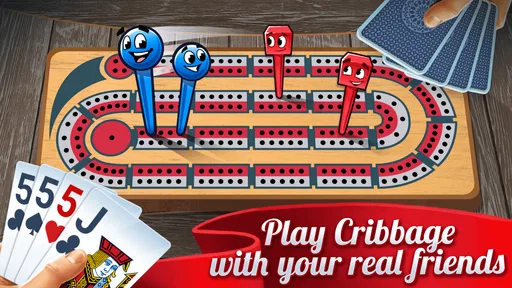
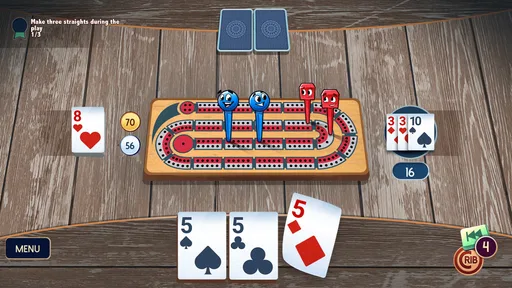
The strongest visual choice here is the decision to let the card table carry the identity. In a game such as this, art direction works best when it makes the state of play immediately readable. Cards need to be easy to distinguish, scoring needs to feel organized and the board should guide my attention toward the current decision. Ultimate Cribbage: Card Board benefits from that practical approach because cribbage already has enough mental texture without decorative clutter.
I do not need a dramatic world-building layer to enjoy this kind of game. The setting is the table itself, and that gives the experience a consistent language. The board, cards and scoring flow all point toward the same idea: this is a compact contest of counting, probability and timing. That coherence matters more to me than flashy effects would. When I return after a few days away, the game still feels immediately understandable.
There is a useful difference between visual simplicity and visual emptiness. A bare card game can feel unfinished if it gives no sense of place, while an overloaded one can make basic actions harder to follow. This game sits closer to the practical middle. Its presentation keeps the mood relaxed enough for casual play, but the board still frames each hand as a proper match rather than a random sequence of cards.
Worth Reading Before You Choose

EA SPORTS FC Mobile 26 Is a Bigger Football Game, but It Takes Time

Flipboard Shows What News Apps Must Do Beyond the Feed

Switching to Android Auto Means Rethinking Your Driving Routine

Google Calendar Makes a Crowded Week Easier to Manage

Ludo King Makes the Most of the Minutes Between Plans

Baby Panda World Brings Quick Play to Modern Phones, but Its Game Library Feels Busy
One detail I value in a cribbage app is how little effort it takes to inspect a position. The best moments come when I can pause over my hand and compare several possible discards without fighting the interface. That is where the visual design becomes part of the strategy. If the cards and board remain legible, I can spend my attention on questions such as whether to protect a pair, preserve a run or avoid feeding the opponent’s crib. The atmosphere is therefore created through usability as much as decoration.
The table setting makes short sessions feel complete
Many mobile card games feel like tools: functional screens that happen to deal cards. This one has a more self-contained table feeling. A hand begins, develops through a few choices and ends with a clear sense of progress. That structure gives even a brief session a beginning and an ending, which is important when I am playing in small pockets of free time.
The game’s age rating of Everyone also fits this presentation. The tone is approachable, the subject matter is harmless and the focus stays on cards rather than mature themes. That does not mean every player will enjoy it equally. Cribbage still asks for patience and attention, and someone looking for constant action may find the table too restrained. The accessible presentation makes the rules less intimidating, but it cannot turn a thoughtful card game into an action game.
There is also a useful trade-off in the modest setting. Because the game does not rely on a large fictional world, I am less likely to feel that I am missing story content or a grand visual journey. On the other hand, players who need character progression, exploration or a strong narrative hook may find the experience narrow. I see that narrowness as intentional rather than a flaw, but it is still an important reason to choose something else if cards are not already your main attraction.
How to read the game’s visual language
For a new player, I would treat the board as a checklist rather than trying to memorize everything at once. First, identify what the current hand can realistically score. Then consider what the discard does to the crib. Finally, keep an eye on the opponent’s position and the pace of the match. The clean table presentation helps because it keeps these questions in the same visual space.
A more advanced habit is to separate a good-looking hand from a good discard. A hand with several combinations may still be the wrong one to keep if it gives the other side an easy crib. I found that the board’s straightforward presentation encourages this kind of comparison. It does not make the decision for me, which is exactly right; it gives me a stable place to make it.
Sound and the feeling of each hand
The audio direction works best when it stays behind the card play. Cribbage is a game of small pauses: I look at the cards, calculate, discard and wait for the next reveal. Loud or overly dramatic sound would make those pauses feel artificial. A restrained audio presence supports the table mood and lets the rhythm come from the decisions themselves.
That rhythm is one of the game’s quiet strengths. The experience moves in cycles rather than in a constant stream. I have time to inspect my options, then the action resolves, then I reassess. This makes it comfortable for relaxed play, but the pacing is not completely sleepy. Once I reach a close position, every discard feels more urgent because the scoring consequences are easier to appreciate.
I especially like this kind of pacing for learning. New players often need time to understand why a choice worked or failed. A game that rushes from hand to hand can make mistakes feel random. Here, the measured structure gives me room to examine the result and build better instincts. I can start by looking for obvious pairs and runs, then gradually pay more attention to defensive discards and the likely value of the crib.
The limitation is that experienced players may eventually want a faster flow. Once I know what I am looking for, repeated pauses can feel less useful, particularly during a run of familiar hands. That is a normal tension in a card game: a pace that helps beginners may feel slow to regular players. I would choose this experience for thoughtful sessions, not for speed-running through as many hands as possible.
Why the soundscape matters even without spectacle
In a small card game, sound does not need to tell a story. Its job is to confirm actions, mark transitions and give the table a little presence. When those elements are handled with restraint, the game feels more polished without drawing attention away from the numbers. I can play while relaxing in the evening and still feel that each hand has a distinct shape.
This also makes the game suitable for players who prefer low-pressure entertainment. I do not have to prepare for a long narrative scene or follow a complicated chain of objectives. The sound and pacing reinforce a repeatable ritual: open the game, play a hand, judge the result and decide whether I want another. That repeatability is more valuable here than novelty for its own sake.
Where the mechanics meet the mood
The rules are the reason the presentation works. Cribbage is not merely about collecting the strongest cards; it is about evaluating several outcomes at once. I have to consider the hand I keep, the cards I send away, the possible scoring after the cut and the danger of helping the opponent. Those layers create tension while the visual and audio design keeps the experience calm.
That contrast gives the game its personality. The table looks settled, but my decisions are not always comfortable. A hand can offer an attractive scoring combination while also creating a generous crib. Another hand may look ordinary but be safer because it limits what the opponent can build. The game’s quiet mood makes these trade-offs stand out rather than hiding them beneath effects.
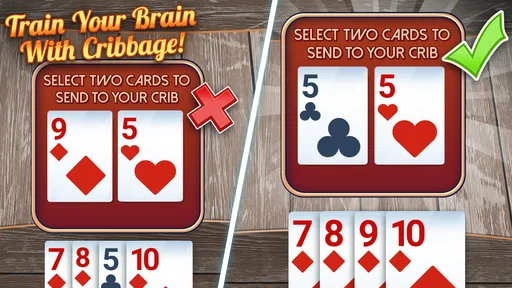
One practical tip is to avoid judging a discard only by the points I can see immediately. I try to ask two separate questions: how much does this card improve my own chances, and how much could it improve the opponent’s crib? That second question is easy to neglect when I am focused on making my own hand look impressive. In close games, restraint can be more valuable than chasing one extra combination.
Another useful approach is to treat the cut as a source of uncertainty rather than a promise. I can prepare a hand with several possible scoring routes, but I should not rely on one exact card appearing. Keeping flexible combinations often produces a steadier result than building everything around a single hopeful reveal. The game does not need to explain this as a tutorial lesson; the hand structure teaches it naturally over time.
I also recommend paying attention to the match position before making a stylish play. When I am comfortably ahead, a safer discard can be sensible. When I am behind, I may need to accept more risk and keep a hand with greater upside. That is where the board becomes more than a score display: it gives context to the same cards. A choice that is reasonable early in a match may be poor when the finish is close.
Learning curve, replay value and everyday use
Someone new to cribbage can approach this game in layers. At first, the goal is simply to recognize common scoring patterns and understand the sequence of a hand. After that, the interesting work begins: estimating the crib, noticing the opponent’s likely priorities and adjusting risk based on the score. The game is accessible at the surface but has enough decision depth to reward continued attention.
That makes it a good fit for a player who enjoys traditional card games but wants a digital table that is always ready. It is also a reasonable choice for someone returning to cribbage after a long break. The compact format lets me rebuild familiarity without committing to a large campaign or learning a new fictional system.
The game is less suitable for players who want a constantly changing challenge structure. If your ideal mobile game includes exploration, unlockable characters, narrative chapters or a wide range of card types, this focused format may feel limited. It is also not the best choice when I want a purely social experience with friends in the same room, because a digital opponent cannot replace the conversation and shared table habits of physical cards.
Compared with a physical cribbage board, the app is more convenient and less prone to setup friction. I do not need to find a deck, clear a table or keep track of pegs. The compromise is tactile: digital cards do not provide the same satisfaction as handling a real deck, and the screen cannot recreate the informal conversation that often surrounds a face-to-face match.
Compared with broad card-game collections, this title is more consistent. A collection can offer variety, but it may also spread attention across solitaire, casino games and unrelated rule sets. Here, the focus stays on cribbage, so the learning and improvement loop feels more direct. If I want one familiar game to revisit, that specialization is an advantage. If I want a different game every few minutes, a collection will probably serve me better.
Free access and the practical trade-offs
The game is free to install, which makes it easy to try without turning the decision into a purchase. It includes in-app purchases ranging from $0.99 to $99.99 per item, so I would approach the optional spending carefully and decide in advance whether I want the free experience or any extras. The important point for me is that the core appeal comes from playing hands and improving decisions, not from needing a large collection of paid content to understand cribbage.
That said, players who dislike any form of in-app purchase may prefer a paid card app with a simpler ownership model. A free download lowers the barrier to entry, but it can also make the overall experience feel less straightforward depending on how optional purchases are presented. I would recommend trying the basic game first rather than assuming that every available purchase is necessary.
The current version is 2.9.6, and the game requires Android 8.0 or later. That makes checking the device requirement worthwhile before installing, especially on an older phone or tablet. The game has passed one million installs, so it is not an obscure experiment, but popularity alone should not decide whether it fits your habits. The more relevant question is whether you enjoy measured, repeatable card play.
Who will enjoy it most
I would recommend this game to someone who likes card decisions with a calm presentation. It suits players who enjoy thinking through a hand, accepting a little uncertainty and learning from repeated mistakes. It also works well for short sessions because the structure is naturally divided into hands rather than requiring a long uninterrupted campaign.
It is particularly appealing if you want to practice cribbage away from a physical board. The digital format makes repetition easy, and repetition is useful here because many lessons only become clear after seeing how different discards affect the outcome. I found that the game rewards curiosity: instead of asking only whether I won, I can ask whether my discard was sensible, whether I overvalued a possible combination or whether I ignored the opponent’s crib.
I would skip it if you need an action-heavy game, a rich story or a constantly evolving visual spectacle. I would also look elsewhere if the main reason you play cards is the social atmosphere of sitting across from another person. Ultimate Cribbage: Card Board can provide the structure of a match, but it cannot recreate every human part of a physical game night.
The atmosphere verdict
After spending time with it, I see the game as a focused cribbage table with a coherent mood. The art direction keeps the board readable, the setting stays centered on the cards and the sound and pacing give each hand room to breathe. None of those choices overwhelms the mechanics, and that is the right priority for this category.
Its best quality is the balance between calm presentation and meaningful decisions. I can play casually, but the game still gives me reasons to improve. The main limitations are equally clear: the narrow focus will not satisfy players seeking broad variety, and the measured rhythm may feel slow once the rules become familiar. The free entry point and Everyone rating make trying it easy, while the purchase range means I would keep a deliberate eye on optional spending.
For me, this is a good recommendation when the goal is not noise but a dependable card ritual. I would open it during a spare ten minutes, use the early hands to settle into the rhythm and then decide whether I am in the mood for a longer match. If you want cribbage presented as a clear, thoughtful table game rather than a flashy collection of distractions, this is a strong fit. It earns its place through readable play, steady atmosphere and the small but lasting satisfaction of making a better discard than I would have made yesterday.
Pros
- Clear scoring makes it easy to follow each hand.
- Several difficulty levels suit both beginners and experienced players.
- Quick matches work well for short gaming sessions.
- Offline play is useful when no internet connection is available.
- Smooth card animations keep the gameplay pleasant and readable.
Cons
- The interface may feel dated compared with newer card games.
- Advanced players may want more detailed statistics and tracking.
- Limited customization can make repeated games feel similar.
- Some opponents may seem predictable at lower difficulty levels.
- Ads may interrupt the experience unless removed through an upgrade.
FAQs for Ultimate Cribbage: Card Board
What is Ultimate Cribbage: Card Board, and how is it played?
Ultimate Cribbage: Card Board is a digital version of the classic Cribbage card game, combining card play with the traditional scoring board. After cards are dealt, you choose cards for your crib, play cards in turns, and score combinations such as pairs, runs, and fifteens. The app is designed to make the rules accessible while preserving the strategy and pacing of physical Cribbage.
Can beginners learn Cribbage easily with this app?
The game can be suitable for beginners, especially if you are unfamiliar with Cribbage scoring or pegging. New players should still expect a learning curve because the game includes several scoring rules and strategic decisions. Before downloading, remember that the app’s usefulness for learning depends on the available tutorials, explanations, and in-game guidance, so experienced players may find the instructional features more limited than a dedicated lesson app.
Does Ultimate Cribbage: Card Board support offline play?
Offline availability can vary depending on the version, device, and specific game mode. Some digital card games allow solo matches against computer opponents without an internet connection, while online features generally require connectivity. If offline play is important to you, check the current store description and permissions before installing, because updates can change which modes, advertisements, or account features remain accessible without an internet connection.
Can I play against other people or only against the computer?
Ultimate Cribbage: Card Board may offer different ways to play, such as matches against computer-controlled opponents and potentially multiplayer features, depending on the platform and current release. Computer play is useful for practicing scoring and strategy at your own pace, while online or local multiplayer can provide a more competitive experience. Review the latest listing to confirm which multiplayer options are available on your device.
Is Ultimate Cribbage: Card Board free to download, and does it include ads or purchases?
The app may be available as a free download, but the overall experience can include advertising, optional purchases, or limitations on certain features. These details may differ between Android and iOS and can change after updates. Before installing, check the official store page for the current pricing model, in-app purchase information, privacy details, and whether removing advertisements requires a separate payment.


